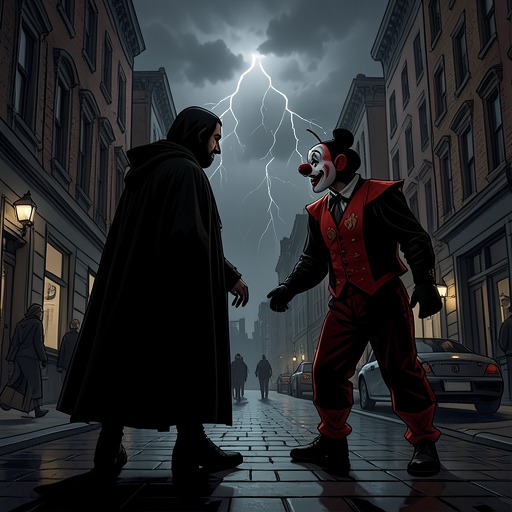
Batman and Joker fight at the amusement park
Batman the Dark Knight Returns 10th Anniversary Edition HardcoverThe Batman–Joker amusement-park battle is the climactic reckoning between Bruce Wayne / Batman and The Joker. It brings their opposed ideas of identity, violence, and responsibility into one grotesque public arena: The Joker converts entertainment into massacre, while Batman enters the amusement park to stop him and settle the conflict that has survived Batman’s retirement. The battle’s decisive significance lies in its double ending. Batman defeats The Joker without directly killing him, preserving Batman’s no-killing principle even as The Joker engineers his own death; afterward, Batman’s apparent death and the political crisis surrounding Gotham City reshape the meaning of their final encounter.
Causes and Background
The confrontation grows out of The Joker’s long catatonic absence and Batman’s return to action. With Bruce Wayne / Batman retired, The Joker remains confined in a condition treated as paralysis of will, but Batman’s reappearance restores the identity against which The Joker defines himself. The earlier conflict between them is therefore not merely a new criminal encounter. It is the revival of a reciprocal pattern in which The Joker’s violence demands Batman’s response, while Batman’s existence gives The Joker’s destructiveness its most charged opponent.
The setting makes that recurrence public and theatrical. The Joker escapes into a city already damaged by social decay, institutional weakness, and escalating disorder, and he takes control of an amusement park whose attractions provide an artificial language of delight for acts of terror. The park becomes a perverse counterpart to Batman’s own symbolic world: both rely on costume, spectacle, and fear, but Batman uses those forms to impose limits on violence, whereas The Joker uses them to erase limits altogether.
The stakes rise beyond the survival of either combatant. The Joker’s attack places civilians in immediate danger and turns private enmity into public slaughter. Batman’s intervention consequently functions as both pursuit and rescue. He is confronting the enemy who has repeatedly challenged his code, but he is also attempting to prevent The Joker from converting Gotham City’s spectators and bystanders into instruments or victims of his performance.
Course of the Battle
Batman follows The Joker to the amusement park after the escape and massacre. The pursuit carries him into a landscape where ordinary entertainment has become evidence of criminal intent: the park’s public character magnifies the consequences of The Joker’s actions, and its attractions provide cover for an assault designed to confuse pleasure with fear. Batman’s return to this scene confirms that The Joker’s reappearance is one of the crises that his renewed mission cannot leave unanswered.
The physical confrontation is shaped by exhaustion, age, and accumulated history. Bruce Wayne / Batman is no longer the untouched figure of his earlier career, yet the battle demonstrates that retirement has not dissolved the habits that define him. He continues to close distance with The Joker, withstands the enemy’s attacks, and treats the encounter as a necessary act of containment rather than as an opportunity for revenge. The Joker, by contrast, behaves as though the battle itself is the desired spectacle; destruction is not a means toward a stable objective but the form through which he asserts his identity.
Their final exchange exposes the difference between them. The Joker seeks to make Batman responsible for the violence that surrounds their rivalry, pressing the confrontation toward a killing that could confirm his belief that Batman and himself are indistinguishable. Batman refuses that conclusion. He disables The Joker and breaks his capacity to continue the attack, but he does not deliberately execute him. The result is a victory that remains morally constrained even at its most violent.
The Joker’s death follows from the wound and from his own decision. Unable or unwilling to accept survival outside the role of Batman’s adversary, he twists his injured body until the remaining damage becomes fatal. This ending makes the battle a final act of self-destruction as much as a defeat. Batman has stopped The Joker, but The Joker denies him the simple narrative of an execution by making his own death the last gesture of the performance.
Consequences and Aftermath
The battle closes The Joker’s active role in Gotham City’s immediate crisis, but it does not restore the city to innocence or stability. The massacre leaves civilian life marked by the consequences of theatrical violence, and the encounter confirms how quickly institutional order can be overwhelmed when a criminal figure can turn a public place into a stage. Batman’s success is therefore protective rather than restorative: he prevents further killing, but he cannot erase what has already happened.
The confrontation also intensifies the conflict over Batman’s legitimacy. To supporters, his intervention demonstrates the necessity of action when the authorities cannot contain The Joker. To opponents, the violence reinforces the image of Batman as a dangerous private force whose methods exist outside ordinary law. The battle thus feeds the same public argument that surrounds his return: whether order is secured by institutional authority, by personal courage, or by coercive power that has not received formal authorization.
Its consequences extend into the later political and military crisis. The apparent death of Bruce Wayne / Batman allows the authorities and the public to believe that the Dark Knight has finally been removed, while Batman uses that assumption in the staged-death strategy that follows. In this sense, the amusement-park battle is not an isolated finale. It helps create the concealment through which Batman can continue his mission, and The Joker’s death becomes part of the transformation from an individual crusade into a hidden legacy.
Meaning Within the Batman–Joker Relationship
The encounter gives their relationship its most complete form. Batman and The Joker are opposites, but the battle shows that opposition does not mean symmetry. The Joker treats chaos as liberation from responsibility; Batman accepts responsibility precisely by imposing restraint on himself. The Joker wants Batman to cross the line into murder so that the distinction between them will collapse. Batman’s refusal preserves the difference, even though the means of the confrontation remain brutal.
Their connection is also defined by recurrence. Batman’s retirement interrupts The Joker’s identity, and Batman’s return awakens it again. The amusement park therefore operates as the endpoint of a cycle in which each figure’s presence gives force to the other’s role. Yet the ending breaks the cycle rather than simply repeating it. The Joker is dead, Batman survives only by appearing dead, and the old public arrangement of hero and villain gives way to a more uncertain future.
The battle’s lasting importance lies in that unstable victory. Batman does not defeat The Joker by cleansing violence from Gotham City, nor does he achieve moral purity by remaining physically untouched. He wins by refusing the final demand that The Joker places before him: to become a killer in order to end a killer. The Joker’s self-inflicted death leaves the rivalry unresolved as a psychological bond, but it confirms Batman’s governing distinction between stopping violence and choosing murder.